

On this page
If you've spent any time in the PMDD corner of TikTok or wellness Instagram, you've probably seen saffron pop up alongside the usual suspects — magnesium, B6, vitex, omega-3s. The pitch is appealing: a beautiful golden spice from your spice cabinet that might rival antidepressants for premenstrual mood symptoms. But is there actually science behind it, or is this just another wellness fad with good marketing?
The short version: saffron has more clinical research behind it for mood than almost any other "natural" remedy you'll see in the PMDD space. But the research specifically on PMDD (not PMS, not general depression) is still thin, and there are real questions about dosing, quality, and who actually benefits. Here's what's actually supported, what isn't, and what to know before you spend $40 on a bottle.
First, a quick refresher on PMDD
Premenstrual Dysphoric Disorder isn't just bad PMS. It's a cyclical mood disorder recognized in the DSM-5 that affects an estimated 3–8% of menstruating people. The hallmark is severe mood symptoms — irritability, depression, anxiety, sometimes suicidal ideation — that emerge in the luteal phase (the roughly two weeks before your period) and resolve within a few days of bleeding starting.
The current scientific consensus is that PMDD isn't caused by abnormal hormone levels. People with PMDD have normal estrogen and progesterone. The issue is an abnormal central nervous system sensitivity to the normal hormonal shifts of the cycle — specifically to allopregnanolone, a neurosteroid metabolite of progesterone that interacts with GABA receptors in the brain. This is why PMDD looks more like a brain-based mood disorder than a "hormone imbalance," and it's why treatments that work tend to be the ones that modulate serotonin, GABA, or ovulation itself.
How saffron is supposed to work
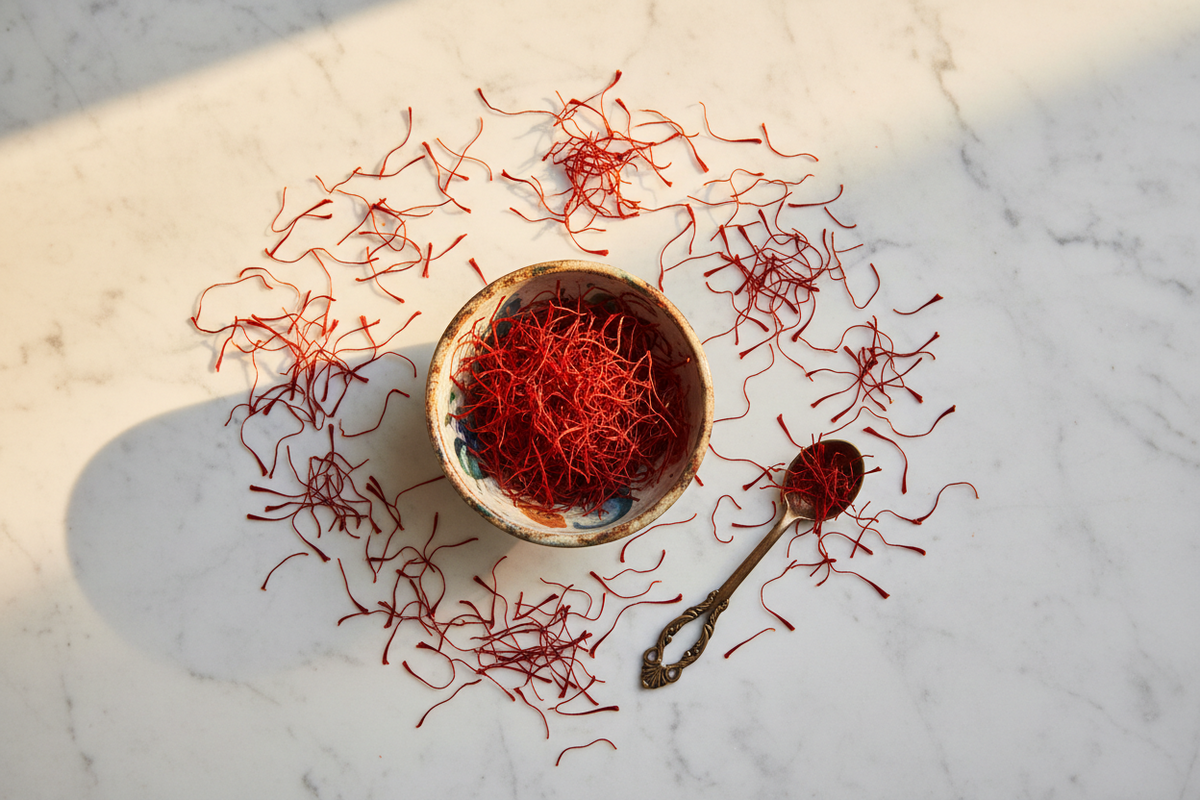
Saffron (Crocus sativus) contains several bioactive compounds — crocin, crocetin, safranal, and picrocrocin are the main ones studied. In animal and cell models, these compounds appear to:
- Inhibit the reuptake of serotonin, dopamine, and norepinephrine — a mechanism similar (but much weaker) to SSRIs and SNRIs
- Modulate GABA-A receptors, which is interesting given PMDD's connection to allopregnanolone and GABA signaling
- Reduce neuroinflammation and oxidative stress, both of which have been implicated in mood disorders
- Influence the HPA axis and cortisol response
That mechanism stack is genuinely intriguing for PMDD because it overlaps with multiple pathways implicated in the condition, rather than just one. Most "natural" mood supplements only hit a single pathway, if any.
What the clinical evidence actually shows
Saffron for depression (the strongest evidence)
This is where saffron has the most data. Multiple randomized controlled trials and several meta-analyses have compared saffron (typically 30 mg/day of a standardized extract) to placebo, fluoxetine, imipramine, and citalopram for mild-to-moderate depression. The consistent finding: saffron outperforms placebo and produces effects roughly comparable to low-to-moderate doses of common antidepressants over 6–8 weeks, with fewer reported side effects.
This is real, replicated evidence — but it's important to be honest about the caveats. Most trials were conducted by overlapping research groups in Iran (where saffron is grown), sample sizes are small, and trial durations are short. Independent replication in larger, longer Western trials is still limited. So: promising and reasonably well-supported, but not bulletproof.
Saffron for PMS
The most-cited PMS study is a 2008 Iranian RCT by Agha-Hosseini et al. that gave 50 women with PMS either 30 mg/day of saffron or placebo over two cycles. About 76% of the saffron group saw a clinically meaningful reduction in PMS symptoms versus 8% of the placebo group, with similar improvements on the Hamilton Depression Rating Scale. The effect size was large.
A handful of smaller follow-up studies have echoed these results, generally showing saffron reduces premenstrual emotional and physical symptoms compared to placebo. It's enough evidence to take seriously, but again — small studies, mostly from the same regional research network, and PMS criteria varied across trials.
Saffron specifically for PMDD
Here's where the trend gets ahead of the science. There is very little research that uses formal DSM-5 PMDD diagnostic criteria as the inclusion standard. Most studies use PMS criteria, which is a much broader and milder category. PMDD is a more severe, more specific condition, and extrapolating from PMS data to PMDD isn't automatic.
That doesn't mean saffron doesn't work for PMDD — the overlap in symptoms and mechanisms makes it plausible. It just means anyone claiming saffron is "proven" for PMDD is overstating the literature. The honest framing is: saffron has solid evidence for depression, decent evidence for PMS, and a reasonable but unproven case for PMDD by extension.
What the typical "effective" dose looks like
Across the depression and PMS trials, the dose that consistently shows up is 30 mg per day of a standardized saffron extract, usually split into two 15 mg doses. The extracts used in research are standardized to specific levels of crocin and safranal (often labeled as affron®, Satiereal®, or similar branded extracts).
This matters more than people realize. Saffron is one of the most expensive spices in the world, and adulteration is rampant — studies have found that a meaningful percentage of saffron sold commercially is cut with safflower, turmeric, or dyed plant fibers. Cooking with saffron threads at home is not going to deliver a therapeutic dose, and a cheap "saffron supplement" with no standardization data is essentially a gamble.
Safety, side effects, and interactions
At studied doses (30 mg/day), saffron has a generally favorable safety profile. Reported side effects are usually mild: nausea, headache, dry mouth, and occasional changes in appetite. But there are some real things to know:
- High doses are not safe. Doses above 1.5 grams per day can cause toxicity, and doses above 5 grams are considered potentially dangerous. This is wildly above any supplement dose, but worth knowing if you're tempted to "stack" sources.
- Pregnancy. Saffron is contraindicated in pregnancy at supplement doses — it has historically been used as an emmenagogue and uterine stimulant.
- Serotonergic interactions. Because saffron appears to have mild serotonergic activity, combining it with SSRIs, SNRIs, MAOIs, tramadol, or other serotonergic medications without clinician oversight isn't a great idea. The risk of serotonin syndrome with saffron alone is theoretical and low, but stacking is where things get murkier.
- Bleeding risk. Saffron may have mild antiplatelet effects, so caution with anticoagulants.
- Bipolar disorder. As with any compound that affects serotonin, there's a theoretical risk of mood elevation or destabilization in people with bipolar disorder.
How to think about saffron in the broader PMDD toolkit
The most effective evidence-based treatments for PMDD remain SSRIs (often used continuously or just in the luteal phase), certain hormonal interventions like drospirenone-containing oral contraceptives, and in severe cases, GnRH agonists or surgical management. Cognitive behavioral therapy also has solid support. These are the heavy hitters, and they exist for a reason.
Where saffron might genuinely fit:
- For someone with mild-to-moderate PMDD symptoms who wants to try a non-pharmaceutical option first, with a clinician's awareness
- As a complement to other lifestyle and nutritional foundations (sleep, blood sugar stability, magnesium, B6, omega-3s) — not as a replacement for them
- For someone who tried an SSRI and didn't tolerate it, and is looking for milder serotonergic support
Where it probably doesn't fit:
- As a standalone treatment for severe PMDD with suicidal ideation — this needs real psychiatric care
- As an add-on to an SSRI without telling your prescriber
- As an expensive replacement for foundational interventions that have stronger evidence
The bottom line
Saffron isn't snake oil, and it isn't a miracle. It's one of the better-studied botanicals in mood research, with replicated evidence for depression and reasonable evidence for PMS. Its application to PMDD specifically is plausible and increasingly popular, but the dedicated PMDD literature is thinner than the trend would suggest.
If you're going to try it, look for a standardized extract at the studied dose (around 30 mg/day), give it a fair 6–8 week trial, track your symptoms across at least two cycles so you can actually see the cyclical pattern, and loop in your clinician — especially if you're on any other medications that affect serotonin. Saffron can be a reasonable tool. It just shouldn't be the only one in the box.
This article is for educational purposes only and is not medical advice. PMDD is a serious condition that deserves real clinical care. Please consult a qualified healthcare provider before starting any supplement, especially if you have a mood disorder or take prescription medications.